The Kauaʻi Endangered Seabird Recovery Project undertakes research projects throughout the island of Kauaʻi. This includes some of the most remote and beautiful locations within Kauaʻi. A selection of our main study sites are included below.
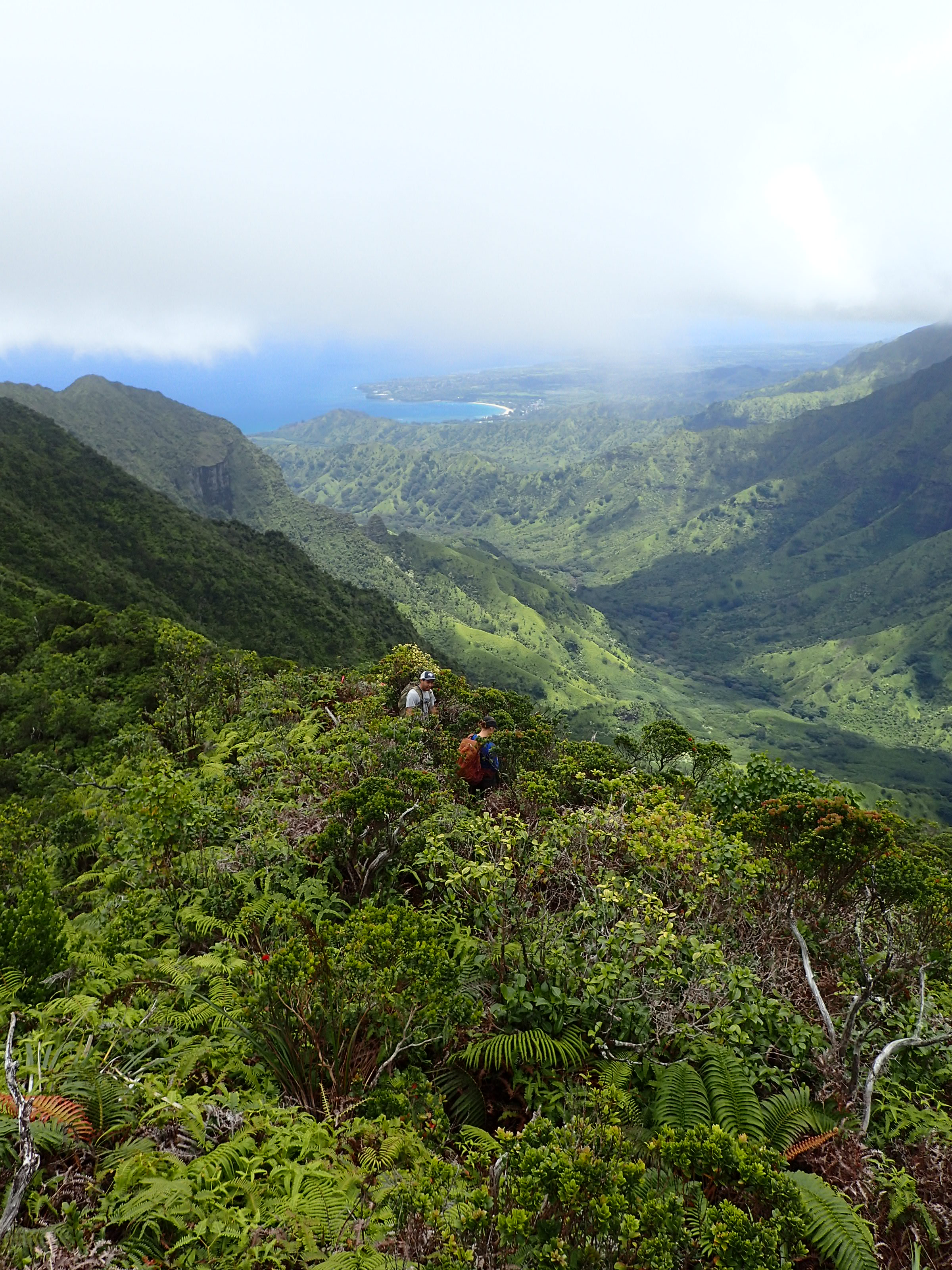
Hono O Nā Pali Natural Area Reserve
This incredibly picturesque reserve occupies 3,578.8 acres in the north of Kauaʻi. Stretching all the way from sea level up to the peak of Pihea (at 4,284 feet), the reserve encompasses 11 different biological communities as varied as mixed montane bog, coastal mesic forest, and montane wet forest. It is in the upper reaches of the reserve that KESRP have identified breeding colonies of both Hawaiian Petrel and Newell’s Shearwater, often nesting in high densities. The remote location, dense natural habitat and distance from human habitation (and light sources) combine to make this one of the most important areas for endangered seabirds remaining in Kauaʻi. KESRP carries out survey trips to Hono O Nā Pali NAR to map seabird breeding distribution, monitor known breeding burrows of both shearwaters and petrels, and provide advice on management actions pertaining to the survival of endangered seabirds within the reserve.
Lehua Islet
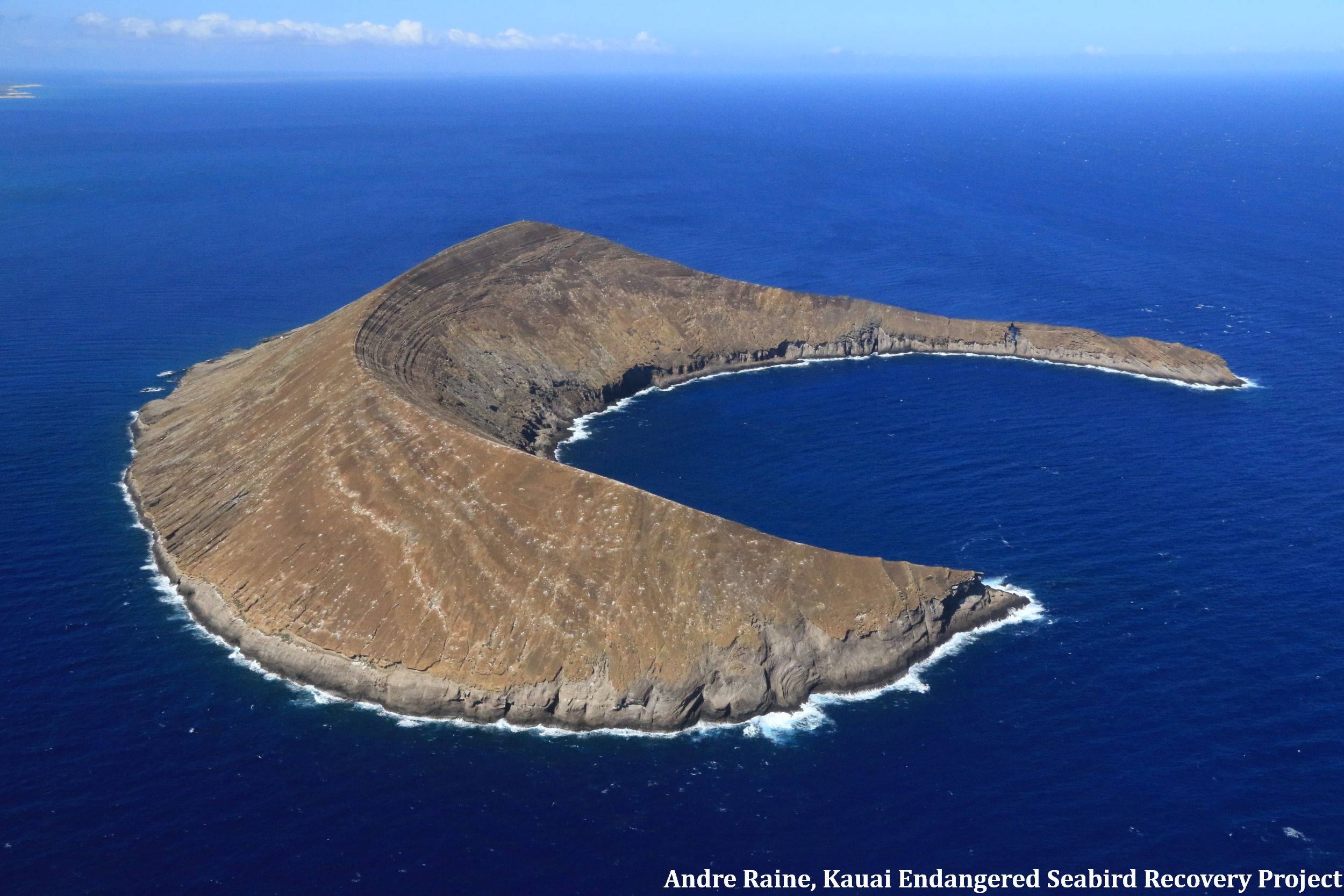
This 284 acre islet sits 31 km due west of Kauaʻi and is only 1.2 km north of the island of Niʻihau. It is a sparsely vegetated, crescent-shaped islet that is actually part of the Niʻihau volcano. After decades of work by a wide range of partners working together as the Lehua Island Ecosystem Restoration project, the islet was declared officially rat free in April 2021. As a state-designated seabird sanctuary with no human inhabitants and no mammalian predators, it is a haven for seabirds with an estimated 25,000 pairs of at least eight breeding seabird species. These include both Laysan (Phoebastria immutabilis) and Black-footed (Phoebastria nigripes) Albatrosses, Red-footed and Brown (Sula leucogaster) boobies, Wedge-tailed Shearwater (Ardenna pacifica), Bulwer’s Petrel (Bulweria bulwerii) and Red-tailed Tropicbird (Phaethon rubricauda) . The islet’s sea caves also hold breeding colonies of Hawaiian Black Noddy (Anous minutus melanogenys). Surveys on Lehua have produced evidence that the islet may also hold small breeding populations of Newell’s Shearwater and Band-rumped Storm-Petrel. KESRP conducts seabird survey and monitoring trips to the islet, with a particular emphasis on monitoring the islet to ensure it remains rat-free. To learn more about the islet and its restoration, visit the Lehua Island Restoration Project website.
Mokuʻaeʻae Rock Islet
Located only 117 meters off of Kīlauea Point National Wildlife Refuge, Mokuʻaeʻae Rock Islet is a 0.3 acre rocky island that rises about 100 feet above sea level. The islet consists of one major plateau ringed by rocky cliffs, tidepools, and slopes dominated by native vegetation such as ʻĀkulikuli (Sesuvium portulacastrum) and ʻĀweoweo (Chenopodium oahuense). It is a state-designated seabird sanctuary and is naturally free of mammalian predators. Mokuʻaeʻae hosts a relatively large colony of breeding Wedge-tailed Shearwaters, as well as smaller breeding populations of Red-tailed Tropicbirds and Bulwer’s Petrels. KESRP conducts a full census of breeding seabirds on the islet at least twice yearly, in addition to monitoring the islet for predators and maintaining a social attraction site aimed at attracting Band-rumped Storm Petrels and Hawaiian Petrels to the islet.
Kīlauea Point National Wildlife Refuge
Kīlauea Point National Wildlife Refuge encompasses 203 acres on the north-east coast of Kauaʻi, two miles north of the town of Kīlauea. The refuge habitat is a coastal complex of steep cliffs abutting the ocean, buildings and small lawns surrounded by dense Beach Naupaka (Scaevola sericea) and Screw Pine (Pandanus tectorius) thickets and a few patches of Common Ironwood (Casuarina equisetifolia) and Coconut (Cocos nucifera). The site is an important breeding area for a number of seabird species including Laysan Albatross (Phoebastria immutabilis), Wedge-tailed Shearwater (Puffinus pacificus), Red-tailed Tropicbird (Phaethon rubricauda) and Red-footed Booby (Sula sula) and also holds a large breeding population of the endangered Nēnē (Branta sandvicensis). The site also holds the only known coastal breeding population of Newell’s Shearwater and is the site of a social attraction project for this species which KESRP helped initiate. For more information about Kīlauea Point and the National Wildlife Refuge system, have a look at their website: http://www.fws.gov/kilaueapoint/
 Kauaʻi Endangered Seabird Recovery Project