
(Bulweria bulwerii)
Hawaiian Name: ʻOu
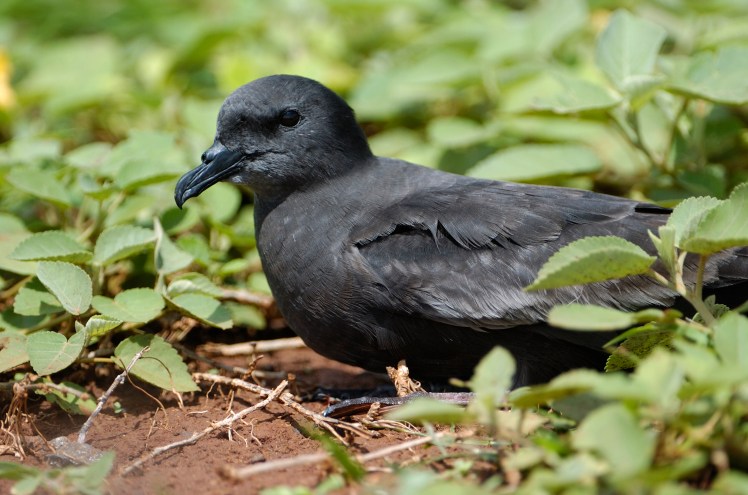
The Bulwer’s Petrel breeds on small islands throughout the North and South Pacific, eastern North Atlantic, and Indian oceans. In Hawaiʻi, colonies exist in the Northwestern Hawaiian Islands and on offshore islets of the main islands, with the largest colony (estimated between 75,000 and 100,000 breeding pairs) being located on Nihoa about 600km northwest of Kauaʻi. KESRP monitors the small Bulwer’s Petrel populations that breed on the two offshore islets of Kauaʻi: Lehua and Mokuʻaeʻae. The nonbreeding season range has not been studied extensively, although individuals have been seen dispersing southeast after breeding in Hawaiʻi.
There are currently no recognized subspecies; however, the timing of breeding in the Cape Verde, Phoenix, and Marquesas Islands is considerably different from other colonies in both the Atlantic and Pacific.
On Lehua and Mokuʻaeʻae, Bulwer’s Petrels breed in rocky terrain, making nests in small cracks, crevices, and within rock rubble. Their small size allows them to use the narrowest of openings to enter and leave their nests, which makes them extremely difficult to locate and monitor. Oftentimes nest activity can’t be observed directly, so nest occupancy in the early breeding season is determined by the presence of the Bulwer’s characteristic strong, musky scent, and by mimicking the soft bark of the Bulwer’s call, to which adults will respond from within their well-protected nest crevices. Elsewhere in Hawaiʻi, Bulwer’s Petrels have been documented nesting in coral rubble, under vegetation, and within constructed nest boxes. Nests usually do not contain a distinct cup, instead consisting of a loose collection of feathers, dry plant material, or rock rubble.
Like other petrels and shearwaters, Bulwer’s Petrels only return to their nests in darkness. This, combined with their small size, quick flight, and dark color, make them extremely difficult to observe in flight.
The Bulwer’s Petrel breeding season in Hawai’i begins in the spring, with eggs being laid from mid-May to mid-June. The nest is attended by both members of the pair, with one adult incubating the single egg while the other forages out at sea. Adults return to feed the chick less and less frequently as it grows, and most fledglings leave their nests by October. Young birds do not revisit colonies for at least two years, instead spending the entirety of their time at sea. First breeding only occurs after about six years. Pairs form long-term bonds, reuniting at the nest site each breeding season.
Adults are overall a dark sooty gray, with a characteristic paler gray bar across the proximal half of the upper wing surface. The bill is a deep black, and legs are pale pinkish gray. Wings and tail are slender and pointed, and flight is erratic and buoyant with quick wing beats. At sea, birds fly low over the water and are often seen foraging alone. Bulwer’s Petrels can be distinguished from the similarly-sized Band-rumped Storm Petrels by the absence of the Band-rump’s characteristic white bar across the upper surface of the rump.
The Bulwer’s Petrel is not currently listed as threatened or endangered. However, significant threats to their breeding colonies exist in Hawaiʻi, including predation by rats and feral cats and chick mortality caused by invasive big-headed ants. Additionally, the species is susceptible to significant impacts from any catastrophic weather events impacting the Nihoa colony, as a large percentage of the global population nests there.
 Kauaʻi Endangered Seabird Recovery Project