
(Phoebastria nigripes)
Hawaiian Name: Ka‘upu
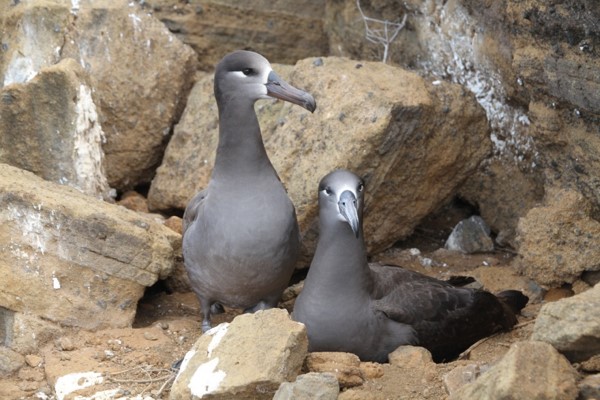
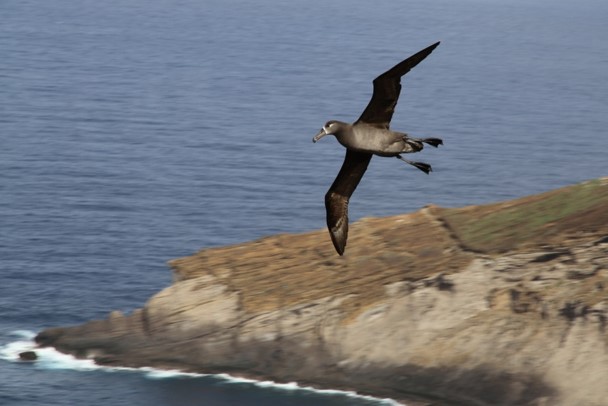
The Black-footed Albatross is one of three albatross species that occur regularly in the north Pacific. It breeds primarily on the Northwestern Hawaiian Islands and the Bonin Islands off Japan, with a small population breeding on Lehua Islet and Kaʻula Island off the Island of Niʻihau. The species is listed on the IUCN Red List as Endangered, with the global population estimated at 200,000 individuals in 1990. Populations are susceptible to incidental take in the longline fishery, consumption of plastics, and an active volcano at the breeding colony on Torishima Island off the coast of Japan.
In Hawaiʻi, the species is easily seen at sea anywhere around the Northwestern Hawaiian Islands during the breeding season, which generally lasts from November to May. During this time they are also regularly seen at sea or from shore from the islands of Kauaʻi and Oʻahu, but there are few to no records from shore from Maui Nui or the Big Island. In all cases, they are far outnumbered by Laysan Albatross in Hawaiian waters. KESRP monitors the population of Black-footed Albatrosses on Lehua Islet.
The Black-footed Albatross is one of two all-dark albatrosses that occur in Hawaiʻi. The Juvenile Short-tailed Albatross is also completely dark, but sports a bubble-gum pink bill, is considerably larger, and is extremely rare in Hawaiʻi, with only a few birds breeding in the Northwestern Hawaiian Islands. Therefore, any all-dark albatross in the Southeastern Hawaiian Islands is almost certainly a Black-footed Albatross. However, the more ubiquitous Laysan Albatross is far easier to see in Hawaiʻi, particularly on Kauaʻi.
 Kauaʻi Endangered Seabird Recovery Project