

ʻŌlelo Hawaiʻi: ‘Akē’akē
Scientific Name: Oceanodroma castro
Conservation Status:
Federal Status: Endangered
State Status: Endangered
IUCN Red List: Least Concern
Population Size
The global population is estimated to be 20,000 to 200,000 individuals. Due to the difficulty in studying this species, the number of birds breeding in Hawaiʻi is currently unknown but is thought to be in the low hundreds.
Distribution
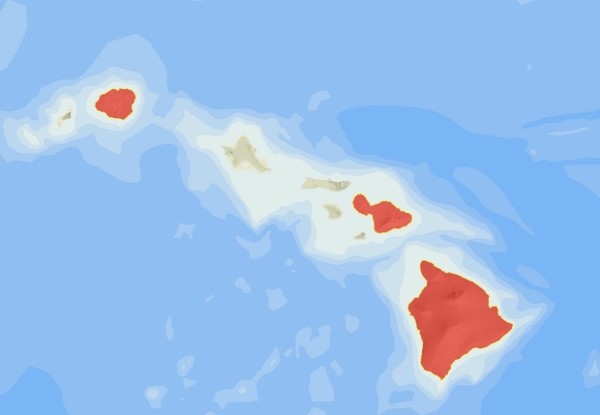
The Band-rumped Storm-Petrel breeds on islands in both the Atlantic and Pacific Oceans. Atlantic populations are found in the Azores, Madeira, Cape Verde, Berlengas, St. Helena, and Ascension Island, while Pacific populations are found in the Galapagos Islands, Japan, and the Hawaiian Islands. The at sea distribution of Band-rumped Storm-Petrel in the Pacific Ocean is largely unknown, but birds have been seen 600 miles north of Hawaiʻi, 1000 miles south of Hawaiʻi, and between Japan and Hawaiʻi. Band-rumped Storm-Petrels in the Atlantic are known to travel immense distances, so it is possible that any of these records could pertain to Hawaiian birds. Other than these records, Band-rumped Storm-Petrels are only known at sea in the immediate vicinity of the Southeastern Hawaiian Islands.
Breeding
As this species prefers to nest in crevices or holes in cliff faces and remote lava flows that are extremely difficult to access, there is much to learn about the breeding biology of this bird in Hawaiʻi. Concentrated calling activity on Kauaʻi, Maui, and the Big Island suggests breeding occurs on these islands and there is a small possibility that a remnant colony may exist on Lehua Islet. During the breeding season, ‘akē’akē have been heard calling in flight over the broad slopes of Mauna Loa on Hawaiʻi, the summit of Haleakalā on Maui, and have been heard ground calling from very steep, rocky cliffs along the Nā Pali coast and Waimea Canyon on the island of Kauaʻi. Young birds of this species have been found along the coast of Kauaʻi, likely attracted to city lights after fledging from the nest. The mummified body of a young storm-petrel was found on Lehua, and single old unoccupied burrows were found along the Nā Pali coast and the southern flank of Mauna Loa. Currently, however, the only confirmed nesting location is within the Pōhakuloa Training Area on Hawaiʻi Island, between 2,090 and 2,210m elevation on the northern slope of Mauna Loa.
Extensive study of ‘akē’akē breeding behavior has not been possible, due to the small number of confirmed and accessible nests. However, some life history traits are known. On Kaua‘i, areas of concentrated calling occur in steep coastal valleys vegetated with shrubs and grasses. On Maui and the island of Hawai‘i, concentrated calling and areas with confirmed nesting occur at high elevations on barren lava flows. Similar to other burrow-nesting seabirds in Hawaiʻi, the ‘akē’akē lays only one egg per breeding season. Eggs are laid between may and June, and chicks leave their nests in the fall. ‘Akē’akē likely do not begin breeding until they are between three and seven years old. While not attending to their egg or chick, ‘akē’akē remain at sea.
Diet and Foraging
Band-rumped Storm-Petrels spend their non-breeding life at sea. They feed only at sea, and eat small fish, squid, and crustaceans. As is typical of other storm-petrels, they often “tap dance” along the water with their feet and flap their wings just above wave crests. This allows them to scoop up prey with their bill at, or just below the surface of the sea. They have been observed feeding during the day, but it is likely that they also feed at night.
Identification
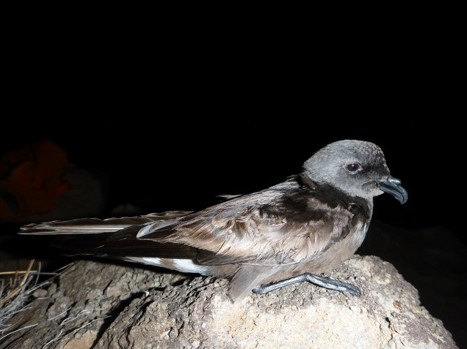
Storm-petrels are very small oceanic birds that are very difficult to observe at sea, and thus hard to identify. Band-rumped Storm-Petrels are often seen from boats during the breeding season from May through September when most other species of storm-petrels are rare in Hawaiian waters. Band-rumped can be distinguished from Leach’s Storm-Petrel by its shearwater-like flight style, narrow and even white rump band and shallow forked tail, whereas Leach’s Storm-Petrel has a very erratic flight style, a white rump band with a indistinct dark line in the middle, and a more deeply forked tail. Wilson’s Storm-Petrel has a the feet extending beyond the very shallowly forked tail, and more rounded wings.
 Kauaʻi Endangered Seabird Recovery Project